


 Warranty Policy
 FAQ
FAQ Download
 Company Events
 Business Events
 Vlog
Vlog Profile
 Why Premteco
 Certificates

 CN
CN EN
EN RU
RU ES
ES AR
AR

High-grade XR LED display-P1.9, P2.6, P2.9

Indoor Small Pitch Mini LED Display-P0.9, P1.25, P1.56

LED Floor Display-P2.5, P2.6, P2.9, P3.9, P4.8,P5.2,P6.25

Extremely Thin 4k LED Display

Fine Pitch LED Display-P2.5, P2, P1.8

Interactive LED Display-P1.2, P1.5, P1.8

Indoor Fine Pitch LED Display-P1.86, P2.0, P2.5, P3.076

Indoor Fine Pitch LED Display

Innovative COB LED Display - P0.78 P0.93 P1.25 P1.56 P1.87

Innovative 4K COB LED Display

Indoor Fine Pitch COB LED Display

Macro High Definition COB LED Display

Indoor Fine Pitch LED Display P0.7, P0.9, P1.25, and P1.56

IP68 Outdoor Front Access LED Display

Outdoor Front Service LED Display-P5, P6, P6.6, P8, P10

IP68 Outdoor Front Service LED Display-P6, P8, P10

Indoor Fully Front Service LED Display - P1.9, P2.6, P2.9, P3.9

Outdoor Front Access LED Display-P4.7, P6.3, P9.5

Outdoor LED Display Screen-P3.9, P4.8, P6.2, P7.8, P10.4

DIP LED Display-P10, P16, P20

SMD Outdoor LED Display-P1.9, P2.6, P3, P4, P6, P8, P10

Die-casting Slim Type Outdoor LED Display-P4, P5, P6.6, P8, P10, P16

IP66 Outdoor Front and Rear Access LED Display

Outdoor Front and Rear Access LED Display P5.71, P6.67, P8 and P10

Cutting-edge Outdoor LED Display Technology Solution

Outdoor Rental LED Display-P2.9, P3.9, P4.8

Outdoor Rental LED Display-P3.9, P4.8, P5.9

High-quality Outdoor Rental LED display-P2.6, P2.9, P3.9, P4.8

Outdoor Rental LED Display-P3.9, P4.8, P5.9

Outdoor Rental LED Display-P2.9, P3.9, P4.8

High Quality Outdoor Rental Transparent LED Display

High Quality Outdoor Rental Transparent LED Display

Indoor LED Display-P2.5, P3, P4, P5

Indoor LED Panel for Rental-P2.6, P2.9, P3.9, P4.8

Indoor LED Panel for Rental-P2.6, P2.9, P3.9

Indoor LED Panel for Rental-P2.6, P2.9, P3.9

Indoor LED Panel for Rental-P2.6, P2.9, P3.9, P4.8

LED Curtain Display-P10.4, P12.5, P15.6, P25, P31.2

Media Facade LED Display-P12, P15, P25, P31, P50

Translucent LED Display-P1.9, P2.8, P3.9, P7.8, P10


Outdoor LED Display Banner-P2, P3, P4, P5

Indoor LED Display Banner-P1.8,P2.5

Indoor LED Display Banner-P1.8,P2.5

Shelf LED Display for Supermarket and Retail Stores


Spherical LED Screen for Indoor and Outdoor Advertising

Sept. 05, 2026< Back to list
COB (Chip-on-Board) gained early traction in the fine-pitch LED market due to its strong surface protection. As pixel pitches reach P0.9, however, issues such as dark-level uniformity and the high cost of single-pixel repairs have become more apparent. MIP (Micro LED in Package) was developed to address these challenges by packaging, testing, and binning Micro LED chips before assembly.
P0.9 is now a key battleground for COB and MIP. COB offers an integrated, well-protected surface, while MIP provides advantages in production yield, pixel replacement, and serviceability. These differences become increasingly important in projects where long-term maintenance and operating costs are major considerations.
This comparison examines COB and MIP across durability, visual performance, maintenance, and total cost of ownership (TCO). The goal is to provide a practical basis for evaluating which technology offers the better balance of performance, maintenance, and long-term value for a given LED display project.
What Is COB LED?
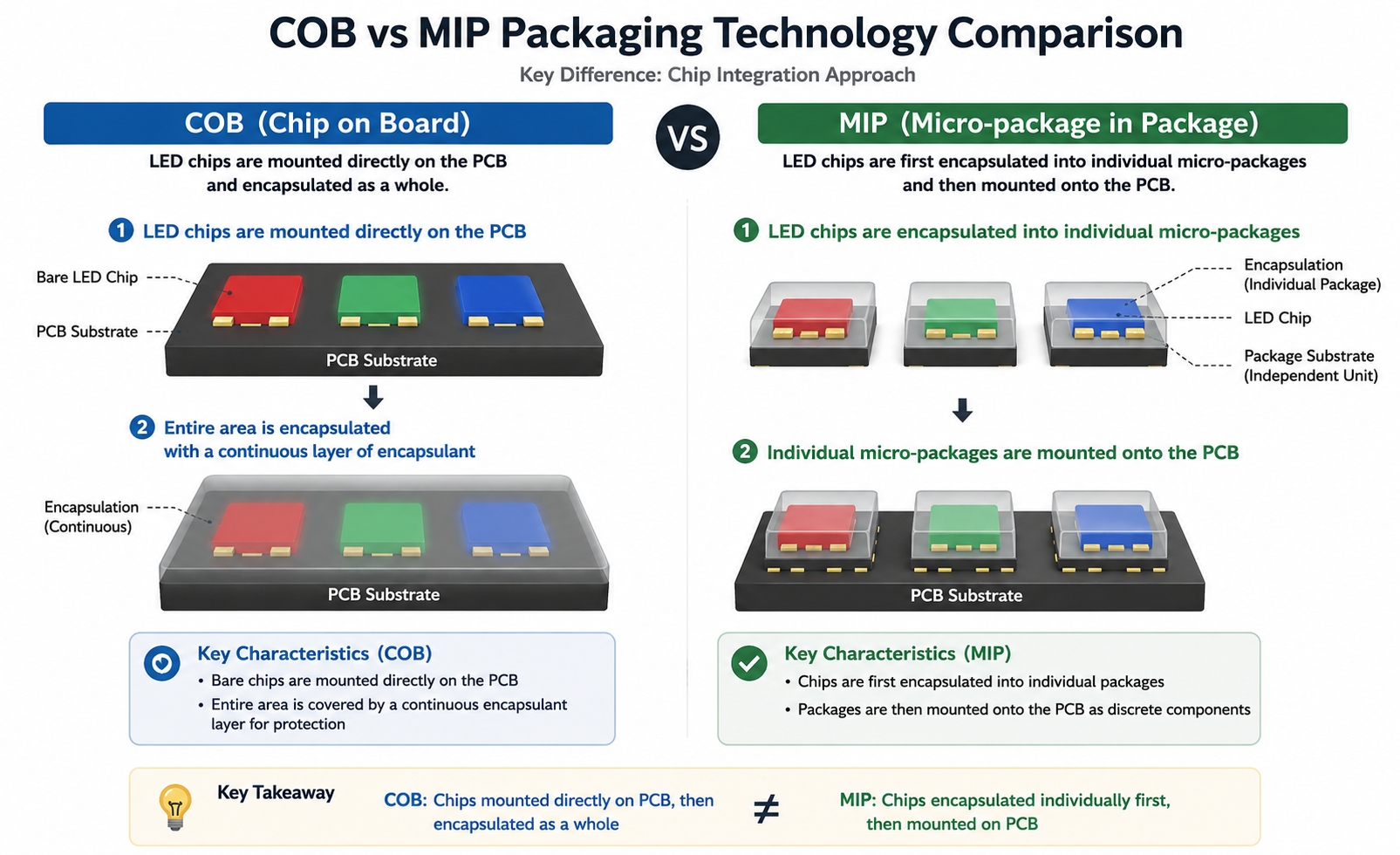
COB (Chip-on-Board) technology is a display solution where bare LED chips are mounted directly onto a PCB substrate and encapsulated with an all-over resin coating. By eliminating discrete, individually packaged lamp beads, this "surface light source" structure provides superior surface protection and a smooth, highly integrated finish.
COB Manufacturing Process: Die Placement → Wire Bonding → Encapsulation → Testing & Calibration
One important characteristic of COB is its continuous encapsulated surface. This can provide additional physical protection for the LED chips and electrical connections.
What Is MIP LED?
Micro LED in Package (MIP) technology is a display technique where Micro LED chips are first individually packaged into miniature lamp beads or packaging units, sorted and binned through optical testing, and then surface-mounted onto PCB substrates. Acting as a bridge solution between conventional COB and direct-mount Micro LED, MIP retains the superior image quality and physical robustness of micro-chips while significantly lowering manufacturing barriers and field repair costs.
MIP Manufacturing Process: Micro LED Packaging → SMT Placement → Reflow Soldering → Testing & Calibration
This approach preserves a more discrete LED package structure while allowing very small LED devices to be used for fine-pitch displays.
However, MIP is not a single standardized product architecture. Different manufacturers may use different package structures, chip sizes, encapsulation materials, and assembly processes. Therefore, specifications such as repairability, contrast, viewing angle, and reliability should always be verified against the actual product rather than assumed from the term “MIP” alone.
Why P0.9 Makes the COB vs MIP Decision More Important
At P0.9, the choice between COB and MIP becomes more important because the extremely fine pixel pitch leaves less room for differences in packaging, optical performance, surface protection, and manufacturing consistency. At this level, packaging technology is more than a manufacturing detail. It can directly affect the performance of the finished display, particularly in close-viewing applications.
P0.9 Amplifies the Impact of Packaging Differences
A P0.9 LED video wall packs a large number of pixels into a small area, making consistency and precision increasingly important. Small differences in LED positioning, package structure, optical characteristics, driving performance, and calibration can become more visible when multiple cabinets are assembled into a large display.
This is where COB and MIP begin to show more meaningful differences. Their different packaging structures can affect surface protection, pixel uniformity, light output, and cabinet-to-cabinet consistency. For buyers, therefore, selecting P0.9 is not simply a matter of choosing the smallest pixel pitch; the underlying packaging technology can have a greater influence on the final viewing experience.
Close Viewing Makes COB vs MIP Differences More Visible
P0.9 displays are commonly installed in environments where viewers are relatively close to the screen. At these distances, differences in black levels, pixel structure, surface reflection, color uniformity, and visible defects can be easier to notice.
As a result, the COB vs MIP decision becomes more consequential at P0.9 than at larger pixel pitches. Buyers should therefore compare both technologies through actual samples or multi-cabinet demonstrations under the intended viewing conditions, rather than relying only on datasheets. The right choice ultimately depends on which packaging approach better meets the project's requirements for image quality, durability, consistency, and viewing distance.
COB vs MIP: Which Technology Performs Better for P0.9
There is no universal winner.
A practical comparison can be summarized as follows:
Key factor | COB | MIP | Winner at P0.9 |
Black Level & Uniformity | More uniform blacks and better overall black appearance | Good black performance, but package gaps may cause slight variation | COB |
Contrast & Viewing Angle | High contrast and wide viewing angle | High contrast with a wide viewing angle | COB |
Pixel Grain / Dot Effect | Smoother, more seamless image | More visible point-source effect | COB |
IP Protection | Strong surface protection and easy cleaning | Protection depends on package and surface treatment | COB |
Failure Rate & Stability | Fewer solder joints and fewer potential failure points | More SMT solder joints and package connections | COB |
Testing & Sorting | Chips are integrated directly onto the PCB | MIP devices can be tested and sorted before assembly | MIP |
Production Compatibility | Requires dedicated bonding and encapsulation equipment | More compatible with mature SMT lines | MIP |
Manufacturing Yield | More sensitive to chip and bonding processes | Individual devices can be tested before assembly | MIP |
On-site Repairability | More difficult to repair on site | Individual MIP devices can be replaced | MIP |
Chip Size Compatibility | Supports Micro LED, but requires high-precision processes | Well suited to Micro/Mini LED package sizes | MIP |
For P0.9 LED displays, COB generally has the edge in image quality, protection, and long-term reliability, while MIP stands out in production flexibility, testing, maintenance, and manufacturing compatibility.
Choose COB If Your Project Prioritizes
Maximum reliability & durability
Prioritize long-term stability, physical protection, and resistance to dust, moisture, impact, and static electricity.
Integrated surface protection
Prefer a highly integrated package with LED chips directly mounted onto the PCB and protected by an integrated encapsulation layer.
Long-term, fixed installations
Prioritize system stability and robustness over component-level replaceability.
Professional and reliability-critical applications
Well suited to control rooms, broadcast studios, command centers, medical visualization, and other professional display environments where reliability is a key consideration.
Choose MIP If Your Project Prioritizes
Maintenance flexibility
Prioritize easier pixel/package-level replacement and more flexible repair options.
Established SMT production processes
Prefer a packaging approach based on standardized packaged LED devices and conventional surface-mount assembly processes.
Flexible product configurations
Prioritize a modular packaging approach that supports different product configurations and production requirements.
Fine-pitch applications with repair flexibility
Prefer a fine-pitch solution that balances high display performance with greater flexibility in component-level maintenance.
Frequently Asked Questions About COB and MIP
Q1: Is COB better than MIP for P0.9 LED displays?
Not necessarily. Both COB and MIP can deliver excellent image quality at P0.9. The better choice depends on the project's priorities. COB is generally favored for physical protection, durability, and long-term stability, while MIP offers greater flexibility for pixel- or package-level maintenance.
Q2: Why is COB considered more durable than MIP?
COB mounts the LED chips directly onto the PCB and protects them with an integrated encapsulation layer. This provides stronger surface protection against dust, moisture, impact, and static electricity, making COB well suited to demanding fixed installations.
Q3: Is COB suitable for long-term 24/7 operation?
Yes. COB is particularly well suited to long-term, fixed installations where durability and system stability are important. However, actual 24/7 reliability depends on the complete display system, including LED components, driver ICs, power supply, thermal management, PCB design, and manufacturing quality.
Q4: Which is better for control rooms: COB or MIP?
For reliability-critical control rooms, COB is often the preferred choice because of its strong physical protection and long-term stability. MIP can still be appropriate when maintenance flexibility and component-level repair are important project requirements.
Still Not Sure: COB or MIP for Your P0.9 Display?
Every project has different priorities. Whether you need maximum durability with COB or greater maintenance flexibility with MIP, the right choice depends on your application, installation environment, and long-term operating requirements.
Share your project requirements with us. Our LED display specialists can help you compare P0.9 COB and MIP solutions and recommend the most suitable option for your application.
Control Room LED Video Walls: How to Choose the Right Display
Flip-Chip vs Wire-Bond COB LED Displays: Key Differences
Flexible LED Displays: Applications and Buying Guide
LED Display Grayscale: Bit Depth and Image Quality Explained
How to Choose an Outdoor LED Billboard: Pixel Pitch, Brightness, IP Rating and Power Consumption
Premteco: special-shaped screen to present a different
How does the LED display follow the 5G trend?
Premteco introduces new design rental screen
Premteco P8 Perimeter LED Screen for Stadium in Canada
Premteco P10 Outdoor Fixed LED Display in Australia
Premteco P1.5 Indoor Full Color LED Screen in Australia
Premteco P8 Outdoor LED Trailer Screen in Australia
Premteco P2.5 Indoor LED Banner Screen in Australia
Premteco P4.8 outdoor LED screen in Qatar
Premteco P1.9 Indoor HD LED screen in Kuwait
Premteco P3.9 Outdoor Rental LED Display in Austria